Hewlett-Packard 608E VHF Signal Generator
Calibrated 50-ohm RF output from approximately 0.1 µV to 1 V, with AM and pulse-modulation facilities.
The 608E in the flesh
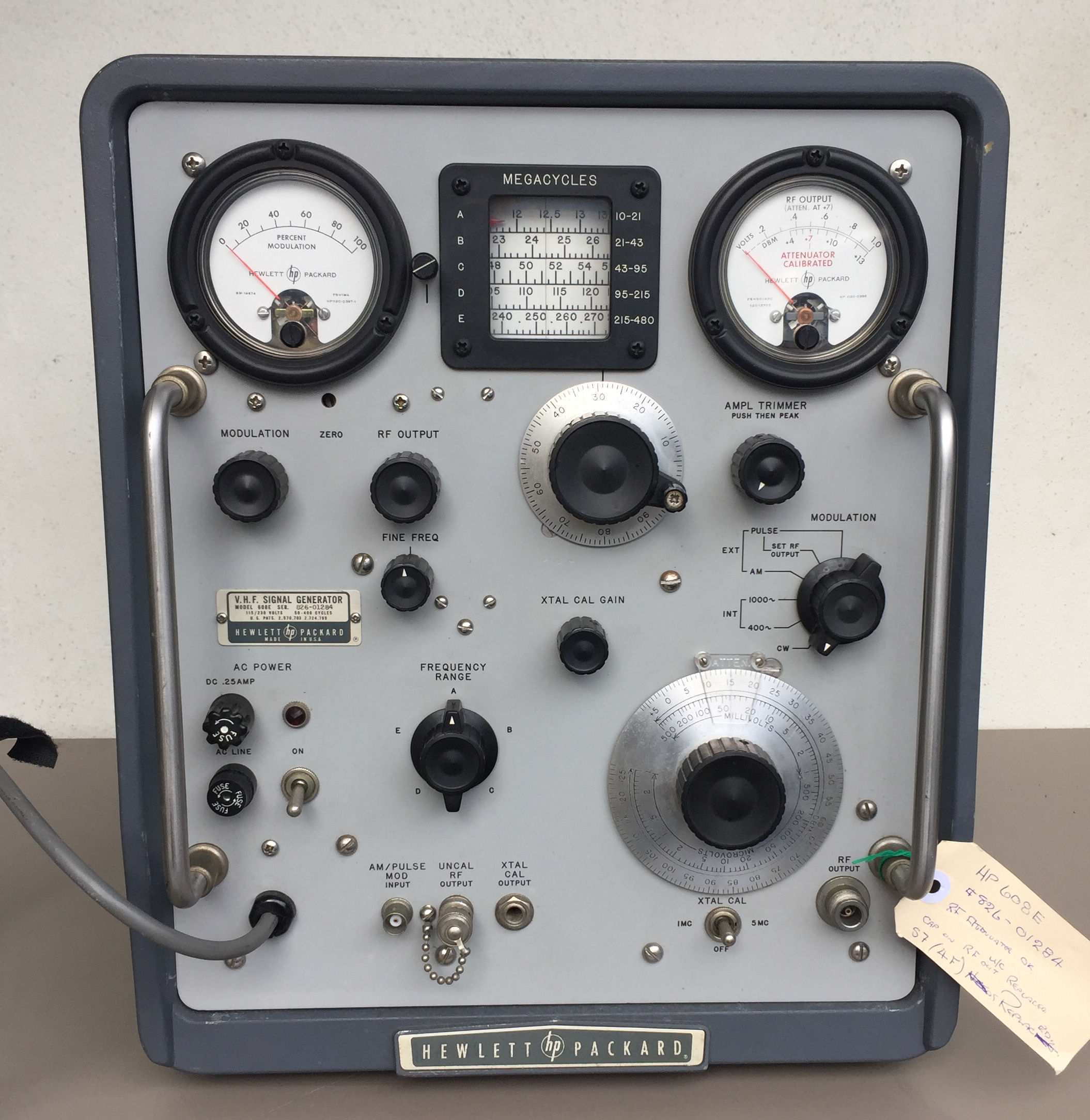
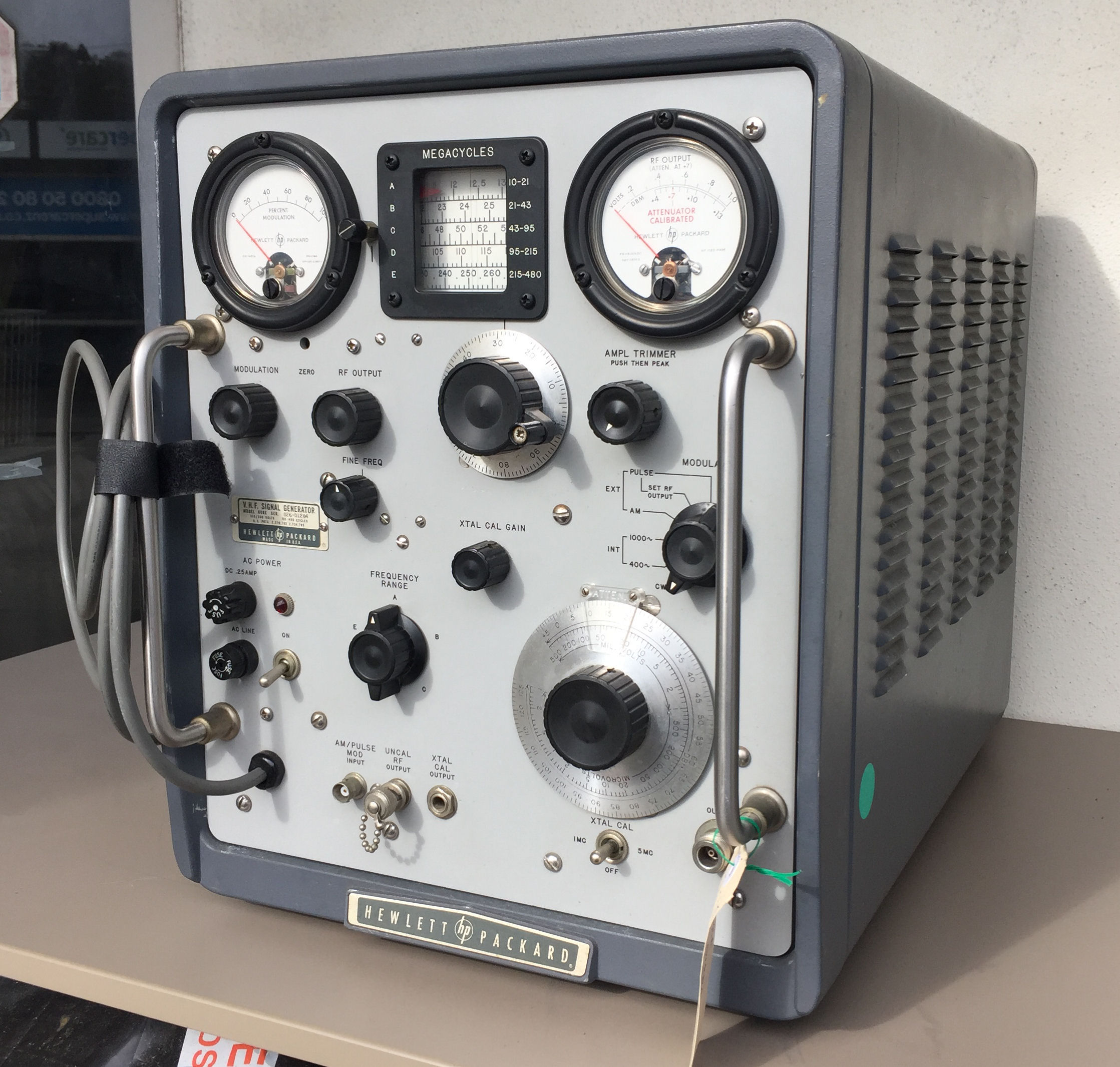
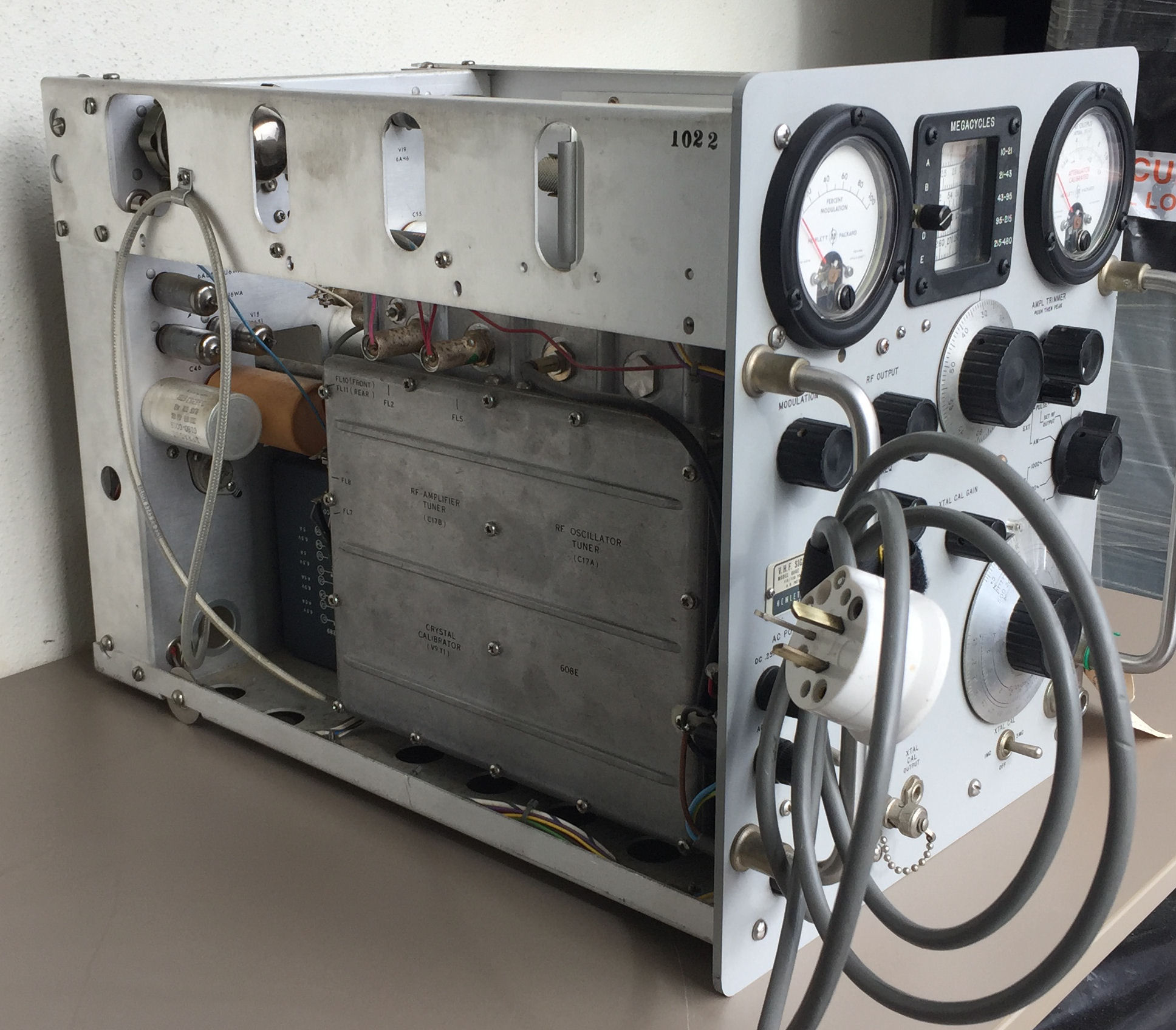
At a glance
| Characteristic | HP 608E |
|---|---|
| Frequency range | 10–480 MHz |
| Frequency bands | 5 |
| RF output | 0.1 µV to 1 V (specified output system; see manual for conditions) |
| Output impedance | 50 Ω |
| Internal AM | 400 Hz and 1 kHz |
| External AM | Approximately 20 Hz–20 kHz |
| AM depth | Up to approximately 95% |
| Pulse modulation | Yes |
| Technology | Valves and transistors |
| Power requirement | Approximately 220 W |
| Weight | Approximately 28 kg |
| Dimensions | Approximately 337 × 416 × 533 mm |
What makes the 608E special?
The first thing that strikes me about the 608E is that it was not merely a frequency source. It was intended to be a measurement instrument.
HP provided calibrated RF output attenuation, a continuously tunable RF oscillator, substantial frequency stability, internal AM, external AM, pulse modulation, a modulation meter, RF output metering, 50-ohm output and facilities intended to work with other laboratory equipment.
That distinction is important. A service-shop signal generator might produce the required frequency, but the HP 608E was intended to provide a known and controlled stimulus to equipment under test.
The extraordinary output range
One of its most useful characteristics is the output range. The 608E provides approximately 0.1 µV to 1 V into its nominal 50-ohm system. That represents an enormous dynamic range: approximately 140 dB of voltage ratio.
This was achieved through the combination of a reasonably powerful RF source and a sophisticated calibrated attenuator system. The attenuator is consequently one of the most important—and potentially most troublesome—parts of a surviving 608E.
Five-band VHF coverage
- 10–21 MHz
- 21–43 MHz
- 43–95 MHz
- 95–215 MHz
- 215–480 MHz
This arrangement is particularly useful for vintage radio and communications work: HF/VHF transition experiments, 27 MHz equipment, FM broadcast, VHF communications, 144 MHz amateur equipment, land-mobile equipment and much of the lower UHF range.
Frequency generation
The 608E combines valves and transistors, rather than belonging cleanly to either generation of technology. Contemporary documentation and surviving examples show a substantial mixture of thermionic and solid-state circuitry.
This hybrid construction is characteristic of HP engineering during the period. The RF generator, mechanical tuning, amplification and calibrated attenuation are integrated into a system designed for predictable laboratory use.
AM capability
Internal modulation is available at 400 Hz and 1 kHz, with adjustable modulation depth. External modulation is also provided. A front-panel modulation meter gives a direct indication of modulation percentage.
For receiver testing, this makes it possible to establish a controlled condition such as a 100 MHz carrier with 1 kHz modulation at a selected modulation percentage, rather than merely asserting that the generator is “modulated”.
Pulse modulation
The 608E can also be pulse modulated. The service documentation specifies combined rise and decay times of less than approximately 4 µs in the 40–220 MHz region and less than approximately 2.5 µs above 220 MHz, under the specified conditions.
This is an unusually sophisticated facility for a generator of this vintage and reinforces the fact that the 608E was intended as laboratory equipment rather than simply a workshop oscillator.
RF leakage control
The design pays careful attention to RF leakage. This matters particularly when measuring receiver sensitivity. A poorly shielded generator can produce a deceptively good sensitivity measurement because RF reaches the receiver by radiation or through unintended paths around the attenuator.
HP's shielding and output architecture were designed with this problem in mind.
The mechanical construction
At approximately 28 kg, the 608E is a substantial piece of equipment. The weight reflects its extensive shielding, mechanical structure, transformers, RF circuitry and precision attenuator assembly.
It belongs to the generation of HP instruments in which the chassis was effectively part of the electrical design. The mechanical engineering is not merely packaging.
Why the attenuator deserves special attention
If restoring or evaluating a 608E today, the RF attenuator should be one of the first areas examined.
The very large output range depends upon its integrity. Possible problems in an elderly instrument include oxidised contacts, contaminated switch surfaces, mechanical wear, incorrect contact pressure, damaged resistive elements, previous attempts at cleaning and calibration errors.
A 608E that “works” is therefore not necessarily a 608E whose output is accurately calibrated.
Calibration is the key question
The correct question is not simply:
“Does it produce RF?”
but:
“How accurately does it produce the RF that its controls claim it is producing?”
For a serious restoration, useful checks include:
- frequency accuracy across all five bands;
- output level at several attenuator settings;
- output flatness versus frequency;
- AM depth and modulation frequency;
- residual AM with modulation disabled;
- RF waveform and spectral purity;
- output impedance / SWR;
- frequency drift after warm-up.
The 608E versus the 608F
It is worth avoiding confusion between the two models. The 608E covers 10–480 MHz with the higher specified output capability, while the 608F covers 10–455 MHz and has a lower maximum output specification. The 608F also incorporates circuitry for phase-lock operation with the HP 8708A synchronizer.
The manuals are unusually valuable
One of the great advantages of owning old HP equipment is the survival of detailed documentation. The 608E/F Operating and Service Manual contains operating instructions, specifications, adjustment procedures, troubleshooting information, parts information, component-location drawings and schematics.
Serial-number identification matters: HP issued different manual/backdating information for different production ranges, so the serial-number prefix should be established before applying a service procedure.
Its place in HP history
The 608 series has a long lineage, including the earlier 608A, 608B, 608C and 608D before the mature 608E/F generation. The 608E therefore represents the accumulated development of a family of HP RF generators rather than an isolated product.
It embodies an engineering philosophy that was already well established at HP: make the instrument mechanically stable, electrically predictable, serviceable, and sufficiently well documented that it can remain useful for decades.
How good is it by modern standards?
| Aspect | Assessment |
|---|---|
| Frequency accuracy | Good for its era, provided the oscillator and calibration are healthy. |
| Frequency stability | Very good for its period. |
| Output accuracy | Potentially very good, but dependent upon the condition and calibration of the attenuator. |
| Spectral purity | Good, although not comparable with a modern synthesised laboratory generator. |
| Convenience | Poor by modern standards: no digital frequency entry or modern memory facilities. |
| Repairability | Excellent—one of its greatest contemporary virtues. |
The surprising conclusion
The HP 608E is not merely an interesting old signal generator. It is an example of instrument engineering from the high period of Hewlett-Packard.
The combination of 10–480 MHz coverage, 50-ohm output, a very wide calibrated output range, calibrated attenuation, AM, pulse modulation, RF metering, shielding, substantial mechanical construction and extensive service documentation made it a genuinely serious laboratory instrument.
Its principal disadvantage today is not performance but convenience. A modern synthesised generator can do much more with a fraction of the bench space and weight.
But the 608E has something the modern instrument often does not:
References
- HP Archive — 608E/608F Operating and Service Manual
- Radiomuseum — Hewlett-Packard 608E
- amplifier.cd — HP 608E VHF Generator (useful photographic reference; photographs remain subject to the site's stated copyright)
- Keysight — 608E/F documentation